

-
Trees
Trees
 Fruit Trees
 Ornamental
 Screening
 Palms
By FeaturesBy Shape
-
Shrubs
Shrubs
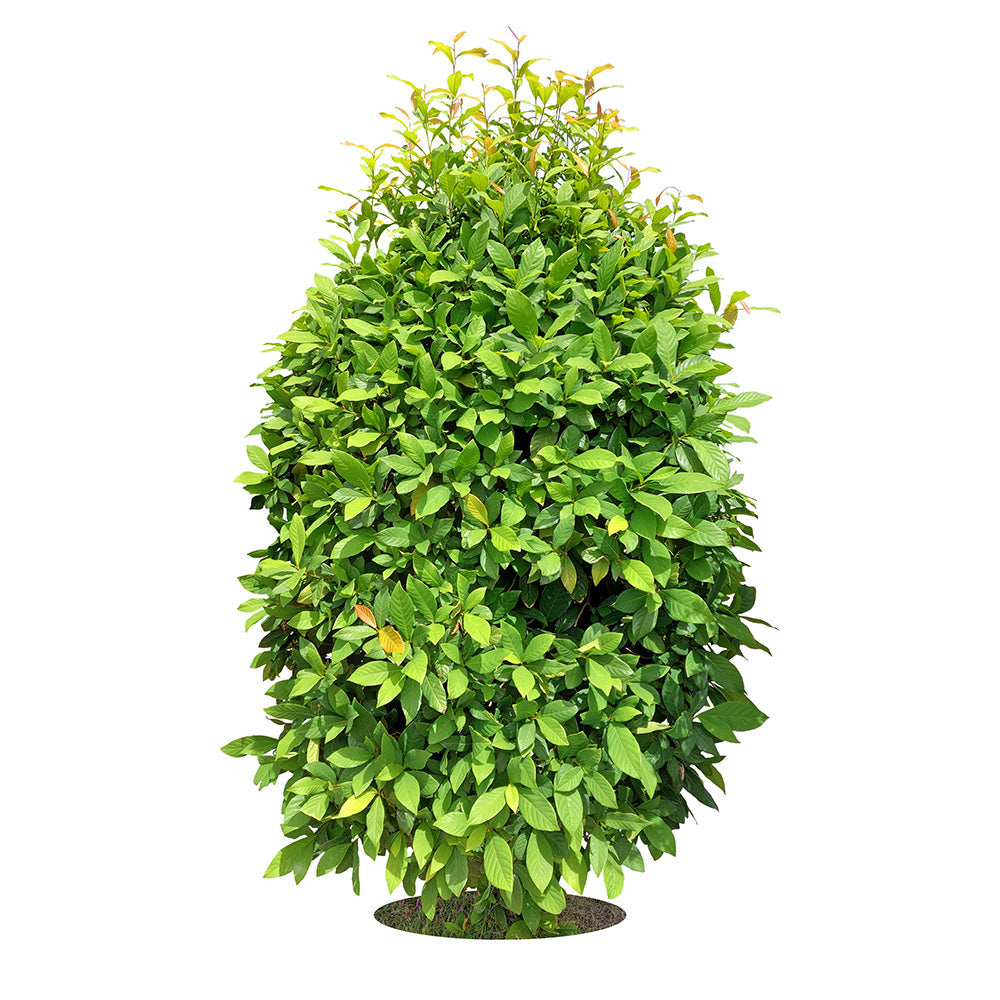 Large shrubs
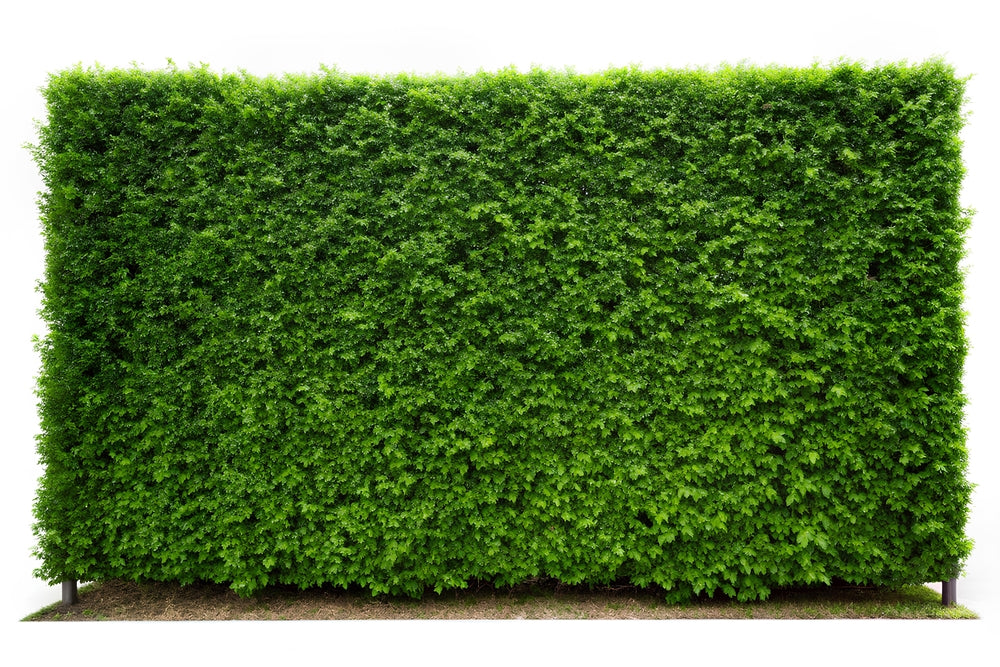 Hedging
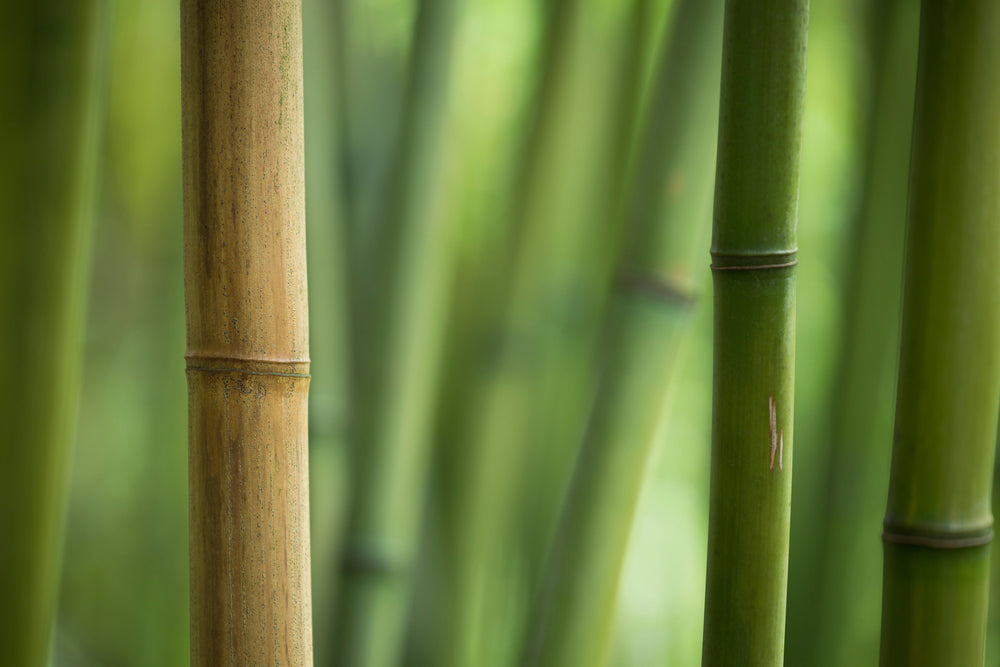 Bamboo
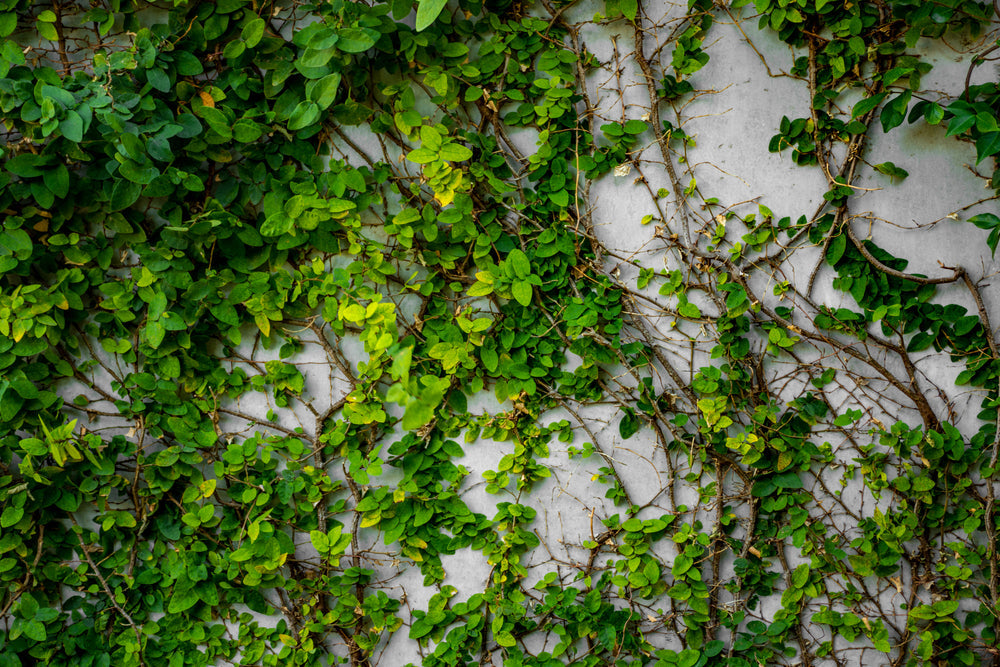 Climbers
 Flowering
 Grasses & Ferns
 Popular
-
Pines & Conifers
Pines & Conifers
 Pines
 Spruce & Fir
 Cypress
 Thuja
 Redwood | Sequoia
-
Specimen
FREE DELIVERY OVER £350
Search results
Search results


Ginkgo biloba | Maidenhair Tree - Bushy - Height 160-190cm - 30lt
£193.00
Unit price perGinkgo biloba | Maidenhair Tree - Bushy - Height 160-190cm - 30lt
£193.00
Unit price perGinkgo biloba is known as a “living fossil”, one of the oldest tree species. It’s a large, long-lived, coniferous, deciduous tree with deeply grooved, grey-brown bark and thick, fan-shaped, bi-lobed, green leaves that turn yellow in autumn. Ginkgo has either male catkins or female single flowers on long stems. Female plants bear unpleasantly scented plum-like fruits, which are actually hard seeds with silvery yellow seed coats.
Ginkgo biloba grows in a wide variety of soils, except too wet and waterlogged, but prefers average, medium moisture, sandy, well-drained soils, in full sun. Once established, it is tolerant of heat, salt, and urban pollution. Generally, disease-free and pest-free. Ginkgo biloba is a perfect specimen plant for large gardens. Great as a shade tree, lawn tree, or planted in espaliers. Very good for streets and parks. Slower-growing varieties are suitable for growing in containers. While young, the crown can be trimmed and trained as desired.


Thujopsis dolabrata - Conifer - Height 30-50cm 12lt
£160.00
Unit price perThujopsis dolabrata - Conifer - Height 30-50cm 12lt
£160.00
Unit price perThujopsis dolabrata is a distinctive evergreen conifer that makes an excellent structural plant for many garden settings. Native to Japan, it forms a dense, pyramidal tree with thick, glossy dark-green foliage and attractive silvery markings on the undersides of the leaves, adding visual interest throughout the year.
This slow-growing conifer is well suited to medium or large gardens where a long-lived, architectural specimen is desired. It performs best in moist, well-drained, slightly acidic to neutral soil and prefers a position in full sun or partial shade. Sheltered locations are ideal, particularly in colder or exposed gardens, as this helps protect the foliage from harsh winter winds.
In a garden design, it works beautifully as a focal point in lawns, woodland gardens, or mixed shrub borders. Its neat habit and rich foliage colour provide a strong evergreen backdrop for flowering shrubs and perennials. Because it grows slowly and maintains a naturally tidy shape, it requires very little pruning or maintenance.
The tree can eventually reach around 10–15 metres in height over many years, but its gradual growth makes it manageable for long-term planting schemes. Hardy and relatively trouble-free, Thujopsis dolabrata is valued for its unusual foliage, strong form, and year-round presence in the garden.


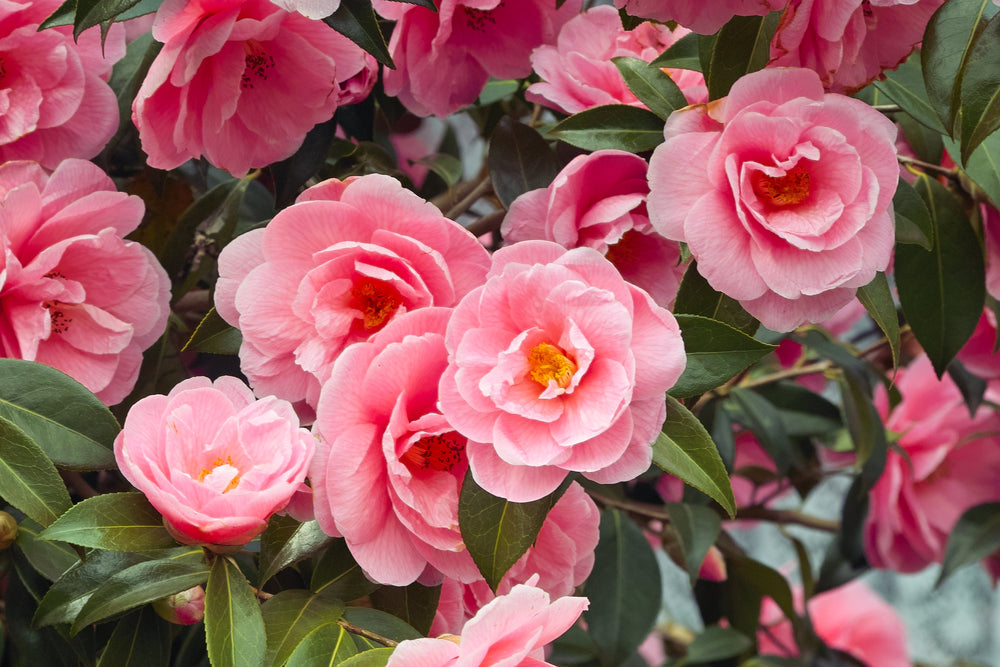
Camellia sasanqua ' Cleopatra' - Large Shrub - Pink - Height 280-300cm - 110lt
£910.00
Unit price perCamellia sasanqua ' Cleopatra' - Large Shrub - Pink - Height 280-300cm - 110lt
£910.00
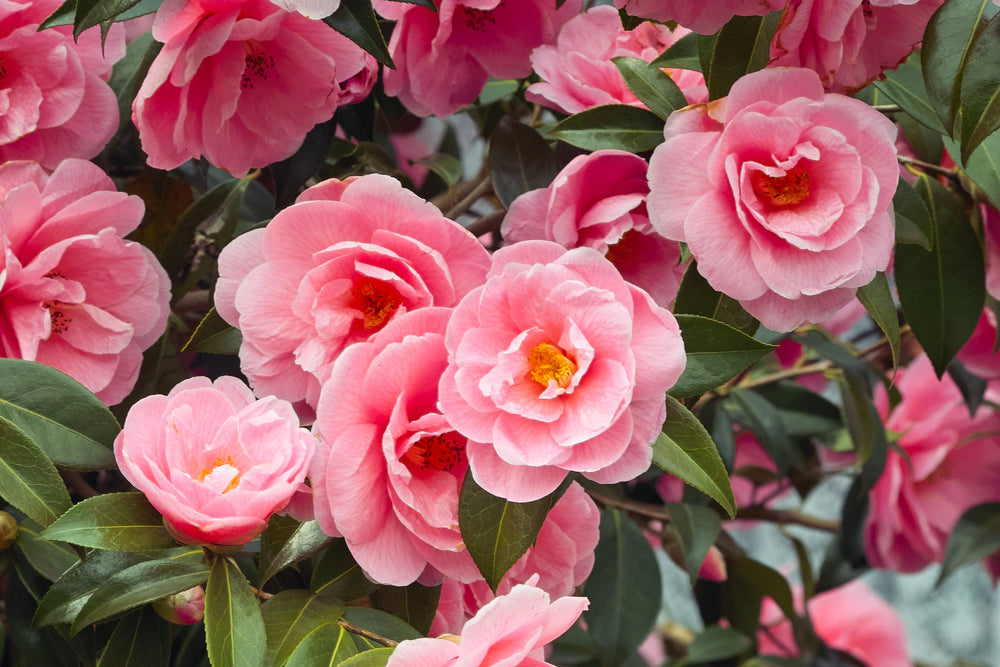
Unit price perCamellia sasanqua ‘Cleopatra’ is a stunning evergreen shrub highly suited to a wide range of garden settings. Reaching around 2–3 metres in height and 1.5–2 metres in width, it forms a dense, upright habit with glossy, deep-green foliage that provides year-round structure and colour. From late autumn through winter, ‘Cleopatra’ produces an abundance of semi-double to double soft pink blooms with golden stamens, adding welcome brightness when few other plants are flowering.
This cultivar thrives in lightly shaded to filtered-sun positions and prefers slightly acidic, well-drained soils enriched with organic matter. Once established, it shows good drought tolerance and responds well to light pruning after flowering, which helps maintain its compact form. Ideal as a feature plant, screen, or hedge, it also performs beautifully in large containers or courtyard gardens. ‘Cleopatra’ attracts pollinators and complements companion plants such as azaleas, gardenias, and ferns. Hardy and versatile, it brings elegance and long-lasting beauty to both traditional and contemporary landscapes, particularly where subtle colour and graceful winter interest are desired.


Magnolia Yellow River - 18cm - 420-430cm - 110lt
£765.00
Unit price perMagnolia Yellow River - 18cm - 420-430cm - 110lt
£765.00
Unit price perMagnolia Yellow River is a stunning deciduous tree that belongs to the Magnoliaceae family. It is native to China and is known for its beautiful yellow flowers that bloom in early spring, before the leaves appear. The tree can grow up to 25 feet in height and has an upright, pyramidal shape.
The flowers of the Magnolia Yellow River are large, cup-shaped, and fragrant, with 6 to 12 petals that are a vibrant yellow color. They measure up to 10 inches in diameter, and the petals often have a hint of pink or green near the base. The blossoms are followed by glossy green leaves that turn a golden yellow color in the fall, creating a beautiful display of color.
Magnolia Yellow River is a hardy tree that is easy to grow and care for, making it a popular choice for gardens and landscapes. It prefers full sun to partial shade and well-drained soil that is rich in organic matter. The tree is relatively drought-tolerant and can withstand occasional flooding.
In addition to its beauty, Magnolia Yellow River has many uses. The bark and leaves contain compounds that have been used in traditional Chinese medicine for centuries to treat a variety of ailments, including headaches, respiratory issues, and digestive problems. The wood is also used in the manufacture of furniture and other products.
Overall, Magnolia Yellow River is a stunning tree that is sure to add beauty and interest to any landscape. Its easy care and many uses make it a great choice for both home gardeners and landscapers.


Magnolia grandiflora | Evergreen Southern Magnolia - Large Bushy Tree - Height 250-300cm - 230lt
£990.00
Unit price perMagnolia grandiflora | Evergreen Southern Magnolia - Large Bushy Tree - Height 250-300cm - 230lt
£990.00
Unit price per


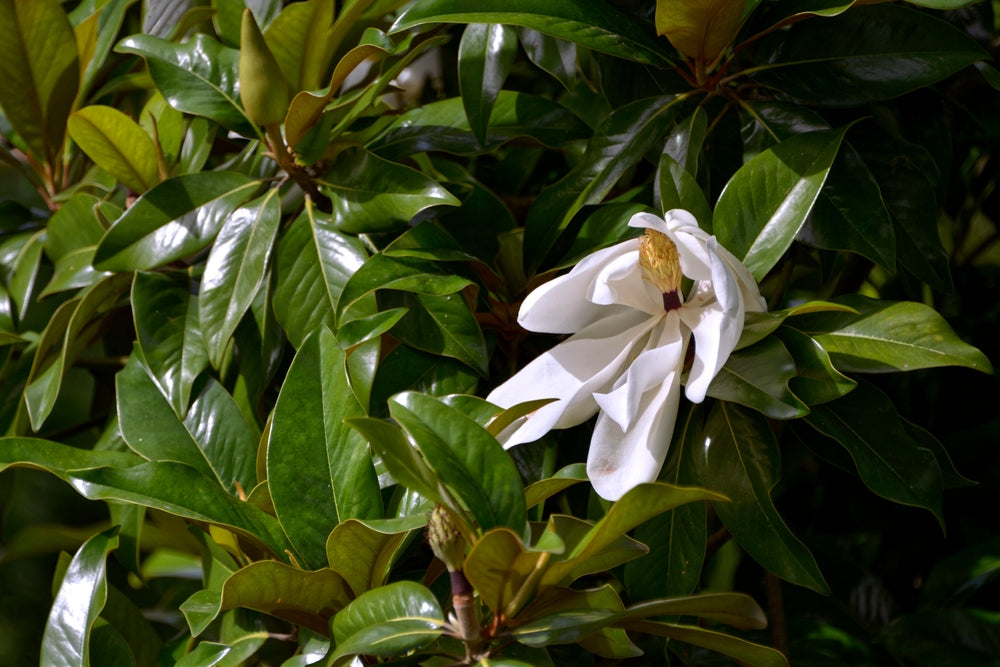
Magnolia grandiflora 'Galissonniere' is an exotic evergreen tree of conical to spreading pyramidal habit, with thick, leathery, glossy green leaves, velvety haired and rusty-brown beneath. Very large, saucer-shaped, creamy-white flowers with purple stamens bloom in summer and early autumn. Their fragrance is strong and pleasant.
Magnolia grandiflora 'Galissonniere' is easily grown in a wide range of soils, but prefers hummus-rich, slightly acidic, moist, and well-drained soils. Once established, it can withstand some drought. It thrives in full sun and partial shade. It has very good cold tolerance, but needs to be sheltered from harsh, dry winds. Low maintenance, it doesn’t require much pruning. Magnolia grandiflora 'Galissonniere' is a French variety of Southern Magnolia cultivated 150 years ago. It’s an excellent ornamental tree, often grown against the wall, rarely free-standing. Great for informal, cottage, woodland, and urban gardens. Excellent for beds and borders, informal hedges and screens, and for growing in containers.


Robinia Pseudoacacia Frisia | Black Locust - Girth 6-8cm - Height 250-300cm - 15lt
£330.00
Unit price perRobinia Pseudoacacia Frisia | Black Locust - Girth 6-8cm - Height 250-300cm - 15lt
£330.00
Unit price perRobinia pseudoacacia 'Frisia' is a captivating and resilient deciduous tree, often recognized by its striking golden-yellow foliage. This robust cultivar stands out for its adaptability and rapid growth, often thriving in diverse environmental conditions, including urban areas with substantial pollution. Originating from the black locust tree, 'Frisia' inherits a hardy and enduring nature, demonstrating significant resistance to harsh weather conditions, rendering it a prevalent choice among garden enthusiasts and landscape architects.
The tree is a magnificent spectacle during the spring season when it is adorned with pendulous clusters of sweetly fragrant, white, pea-like flowers, attracting a myriad of pollinators, notably bees, enhancing biodiversity within its vicinity. The blooms are followed by smooth, elongated seed pods, contributing to the tree's visual appeal. The vibrant foliage, which creates a pronounced contrast with the surroundings, transitions to a lighter shade of yellow in the autumn, offering an extended period of visual interest.
Despite its aesthetic appeal and resilience, 'Frisia' necessitates vigilant management due to its propensity for suckering and its invasive nature. Proper pruning is vital to maintain its structural integrity and curtail unrestrained growth. This tree is suitable for individuals seeking a low-maintenance yet visually arresting focal point in their landscapes.
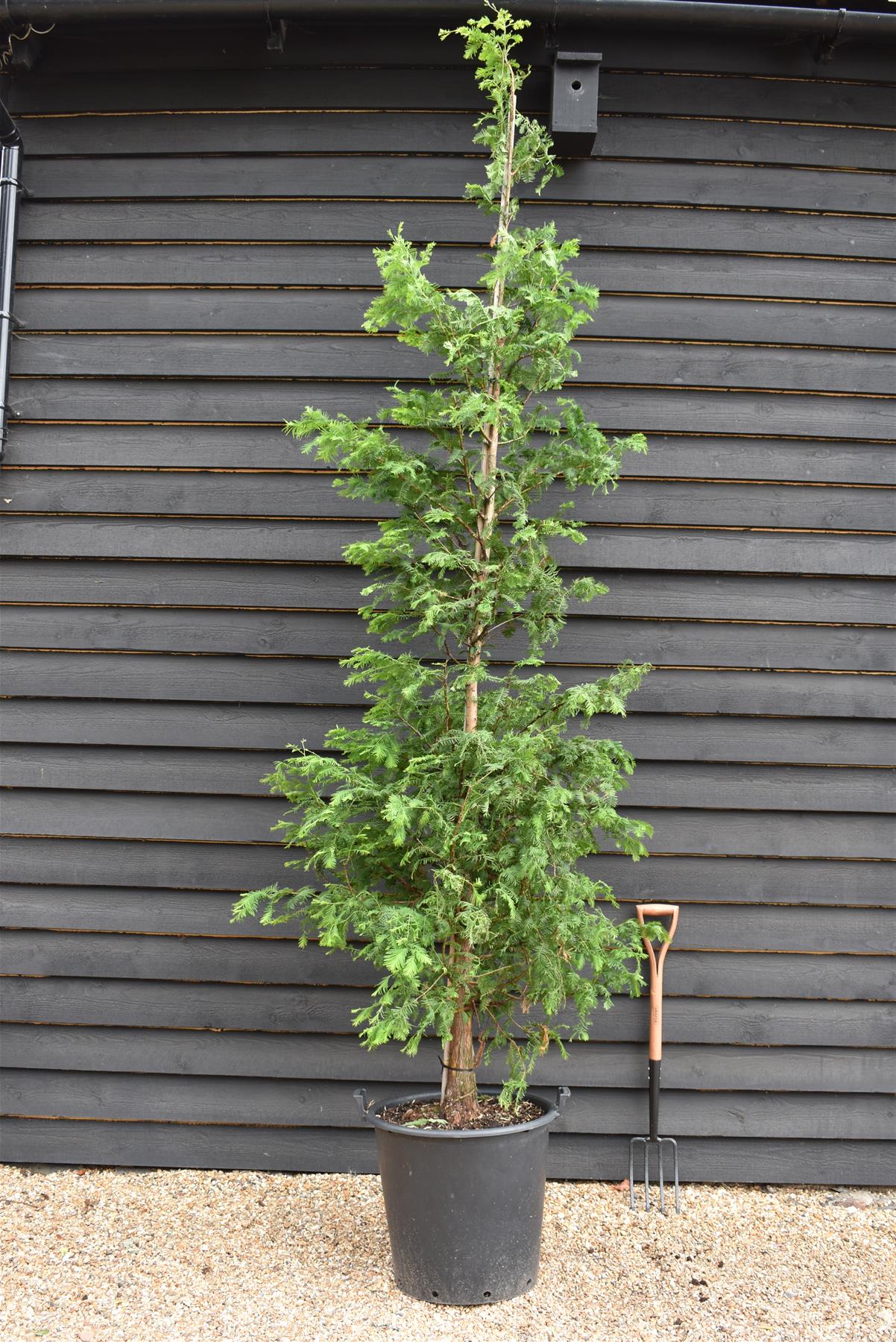

Metasequoia glyptostroboides | Dawn Redwood - Girth 10-12cm - Height 320-340cm - 70lt
£490.00
Unit price perMetasequoia glyptostroboides | Dawn Redwood - Girth 10-12cm - Height 320-340cm - 70lt
£490.00
Unit price perThe Metasequoia glyptostroboides, commonly known as the dawn redwood, is a deciduous conifer belonging to the family Cupressaceae. It is one of only three species of redwood trees and is renowned for its prehistoric origins, often referred to as a "living fossil."
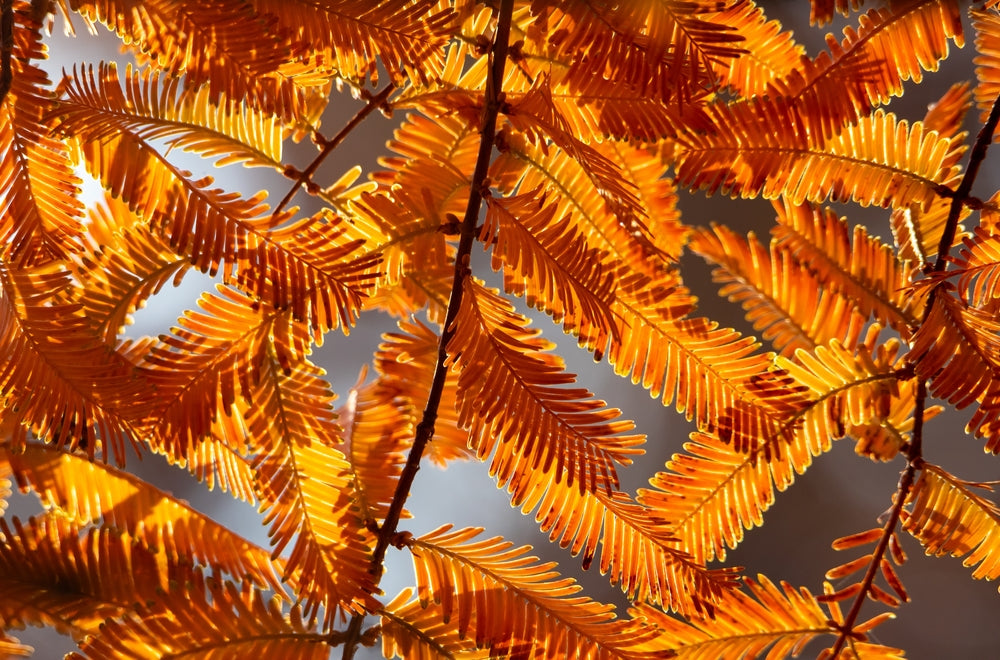
This remarkable tree can grow to impressive heights of up to 40 metres (130 feet) with a conical shape. The bark is reddish-brown, fibrous, and peels off in long strips, giving it a distinctive appearance. The leaves are needle-like, arranged oppositely on the branches, and turn a rich bronze or golden-brown before falling in the autumn. This seasonal shedding of leaves distinguishes the dawn redwood from its evergreen relatives.
Metasequoia glyptostroboides thrives in temperate climates and prefers moist, well-drained soils, often found near rivers and wetlands. Its growth rate is rapid, making it a popular choice for ornamental planting in parks and gardens worldwide. Despite its prehistoric lineage, the dawn redwood has adapted well to cultivation and can withstand urban conditions, including pollution and compacted soils.
The tree's history is fascinating, as it was once thought to be extinct and only known through fossil records until its rediscovery in the 1940s. Since then, efforts have been made to propagate and preserve this species, ensuring its survival and increasing its presence in both natural and managed landscapes.


Photinia Red Robin | Christmas berry - Frame/Espailer 150 x 100 - Height 180cm - 55lt Frame - 200-210cm, 55lt
£365.00
Unit price perPhotinia Red Robin | Christmas berry - Frame/Espailer 150 x 100 - Height 180cm - 55lt Frame - 200-210cm, 55lt
£365.00
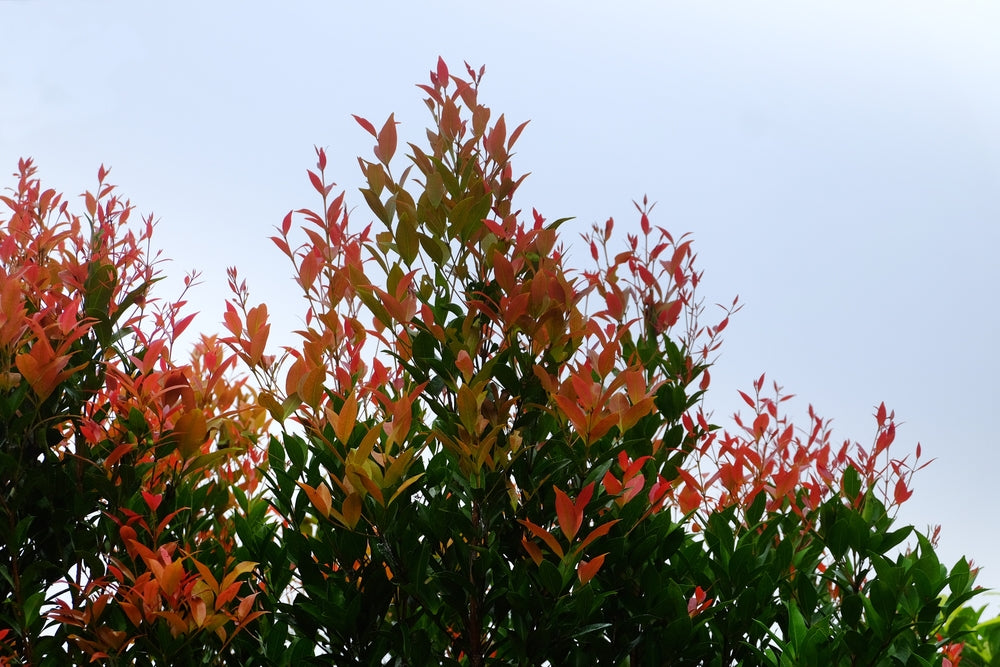
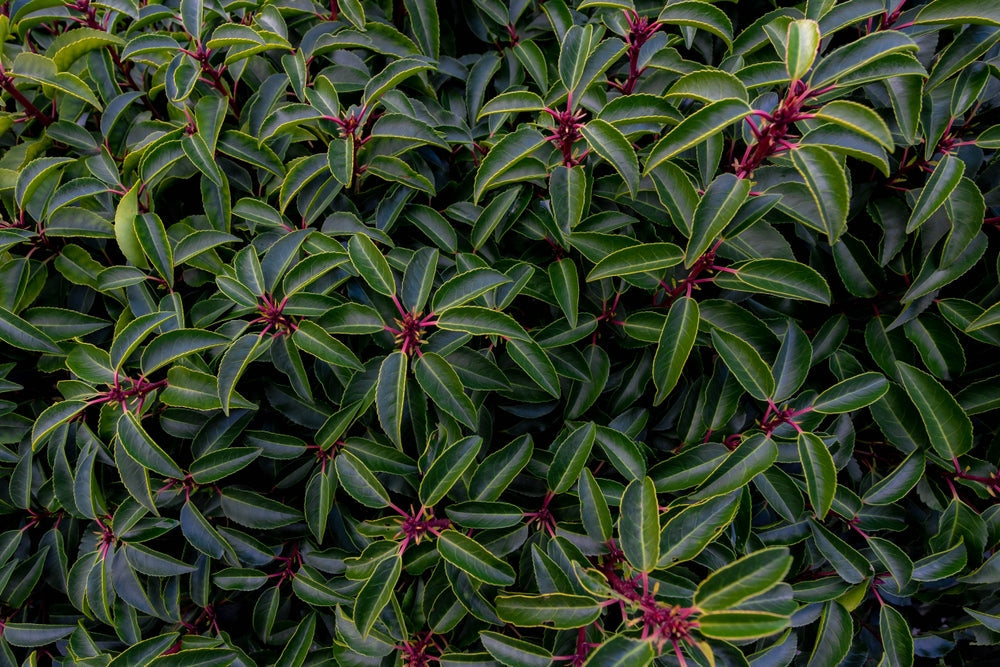
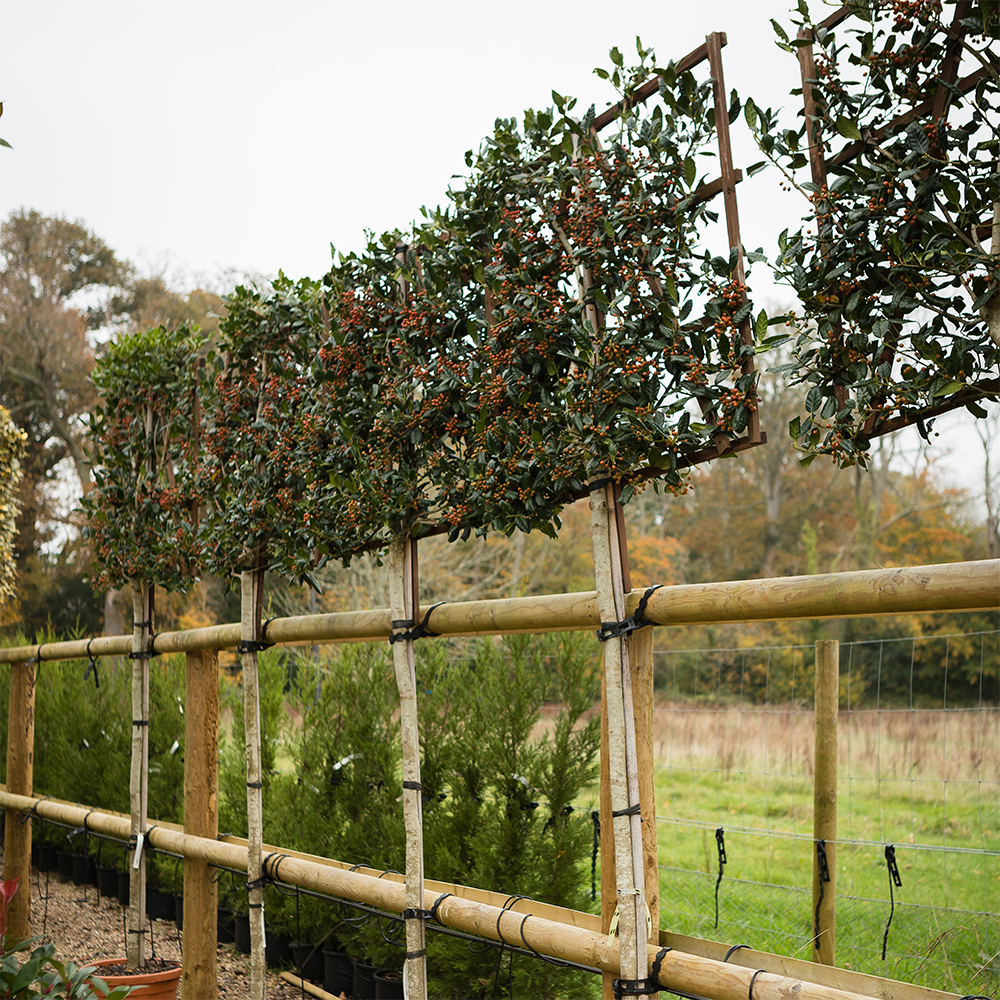
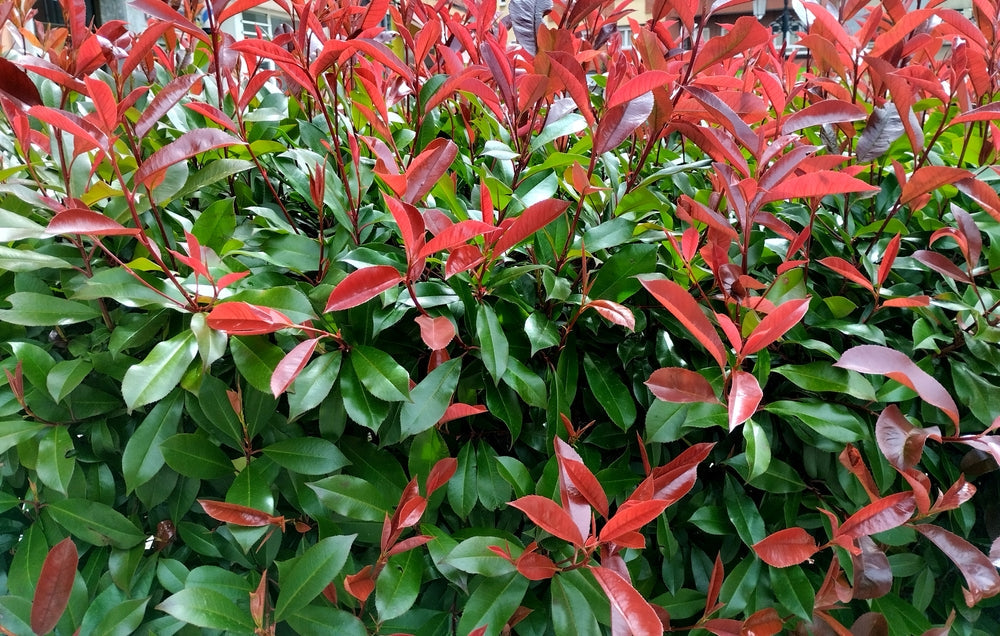
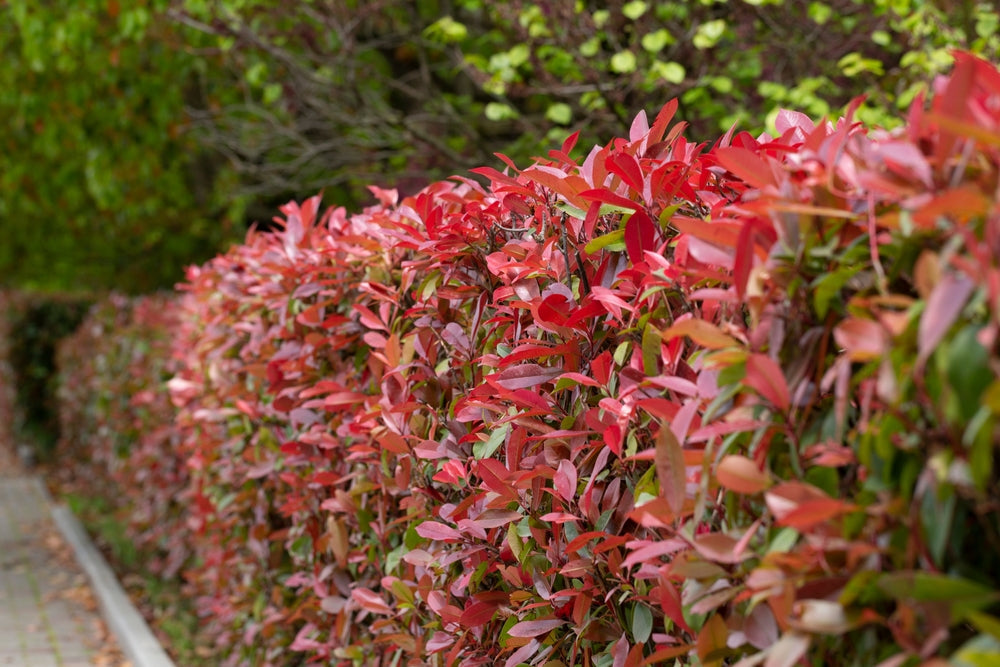
Unit price perPhotinia ‘Red Robin’ trained as a frame or espalier (150 × 100 cm) is a brilliant choice for adding structured, evergreen interest to a garden. Its striking young foliage emerges bright red before maturing to glossy dark green, providing continuous seasonal contrast and visual appeal.
This trained form is particularly well suited to formal gardens, courtyards, and contemporary outdoor spaces where clean lines and defined shapes are desired. It works beautifully against walls or fences, making it ideal for screening, dividing spaces, or creating a decorative feature without taking up excessive ground space.
Thriving in full sun or partial shade, Photinia prefers well-drained soil and a sheltered position, protected from harsh winds which can damage young growth. Once established, it is relatively hardy and tolerant of urban pollution, making it suitable for town gardens.
Reaching its trained dimensions with regular maintenance, it responds well to pruning, which also encourages vibrant red regrowth. Low maintenance and versatile, this espalier form is perfect for adding height, structure, and year-round colour to both modern and traditional garden designs.
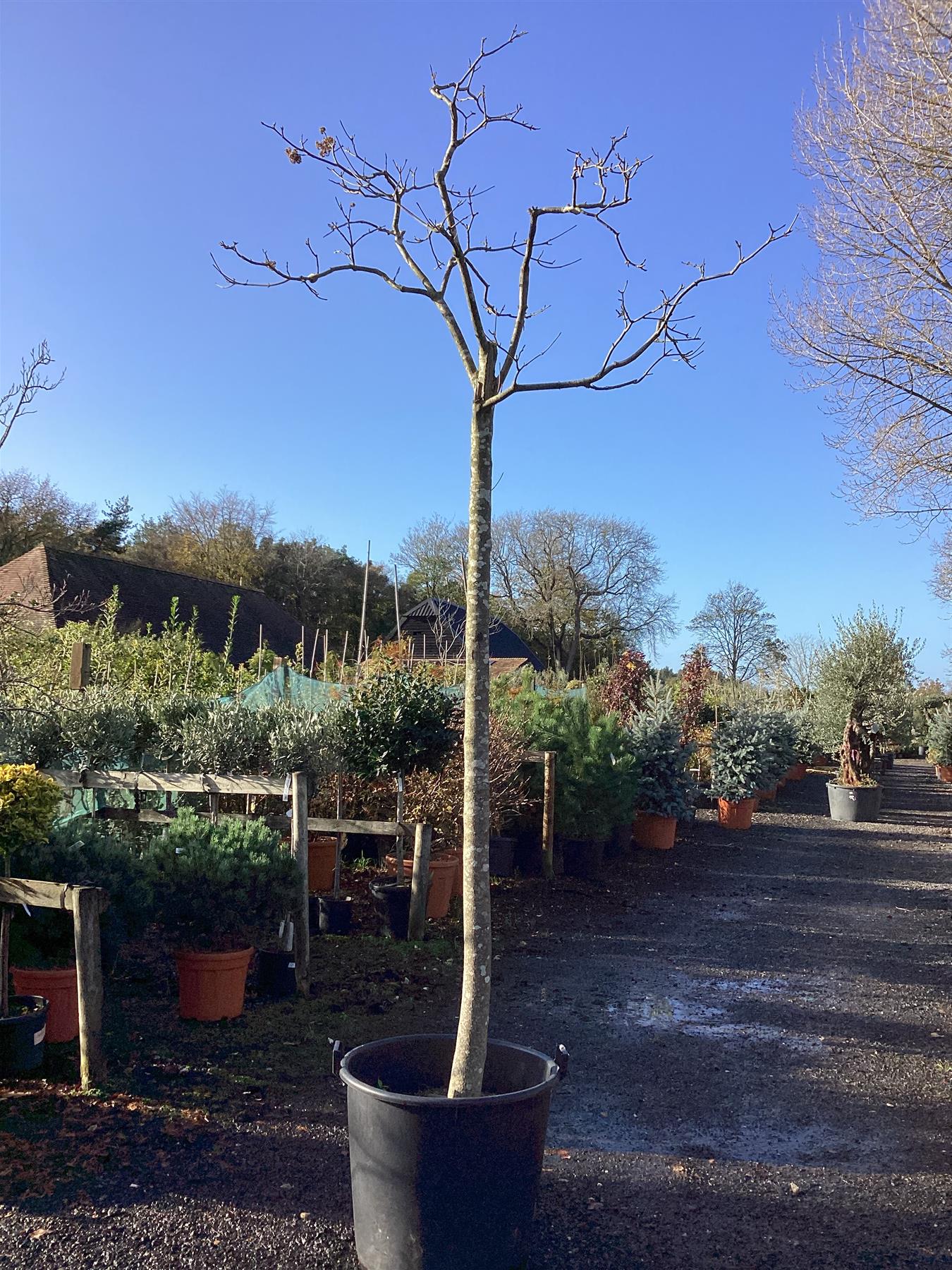
Halesia | Carolina silverbell - 300-350cm, 90lt
£365.00
Unit price perHalesia | Carolina silverbell - 300-350cm, 90lt
£365.00
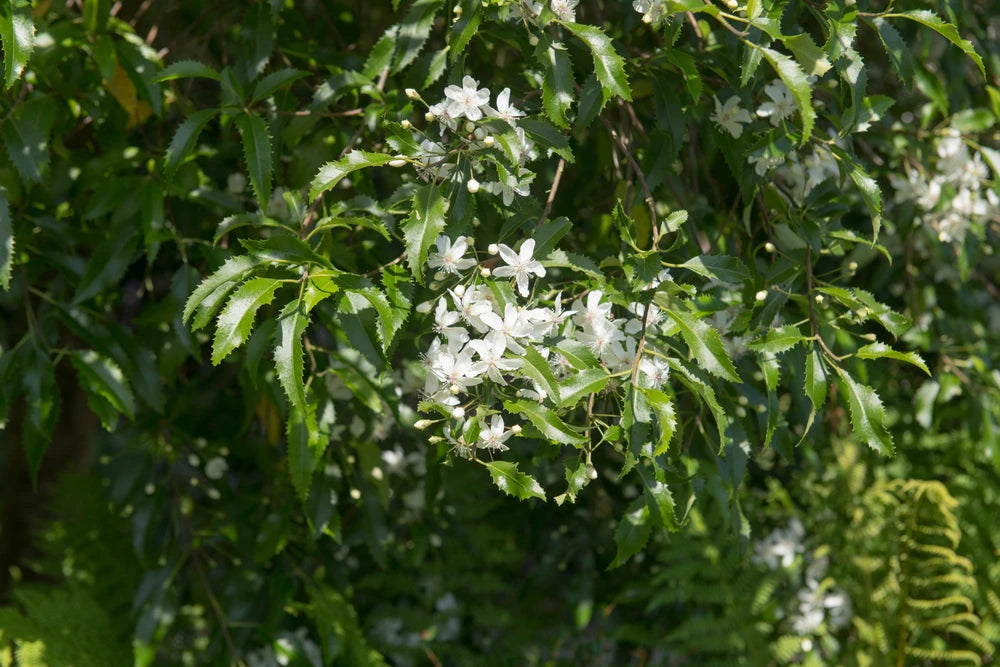
Unit price perHalesia, or Silverbell, is a small genus of five species (H. carolina, H. diptera, H. macgregorii, H. tetraptera, and H. monticola) of large, deciduous shrubs or small trees with grey bark, and simple, ovate, green leaves, that turn yellow in autumn and fall off early. Attractive, hanging, bell-shaped, white to pale pink flowers grow in clusters and bloom in spring. Flowers are followed by four-winged (or two-winged), nut-like fruits in autumn and often remain on branches long into winter. Attractive to bees and squirrels. Halesia grows best in average, organically rich, slightly acidic, lime-free, moist but well-drained soils. It prefers partial shade, but tolerates full sun. Doesn’t have any serious pest or disease problems. Low maintenance plant, no routine pruning necessary. Halesia is a wonderful shrub or small tree perfect as an understory plant, for shrub borders, stream banks, or woodland gardens. Great as a specimen plant for the lawn.
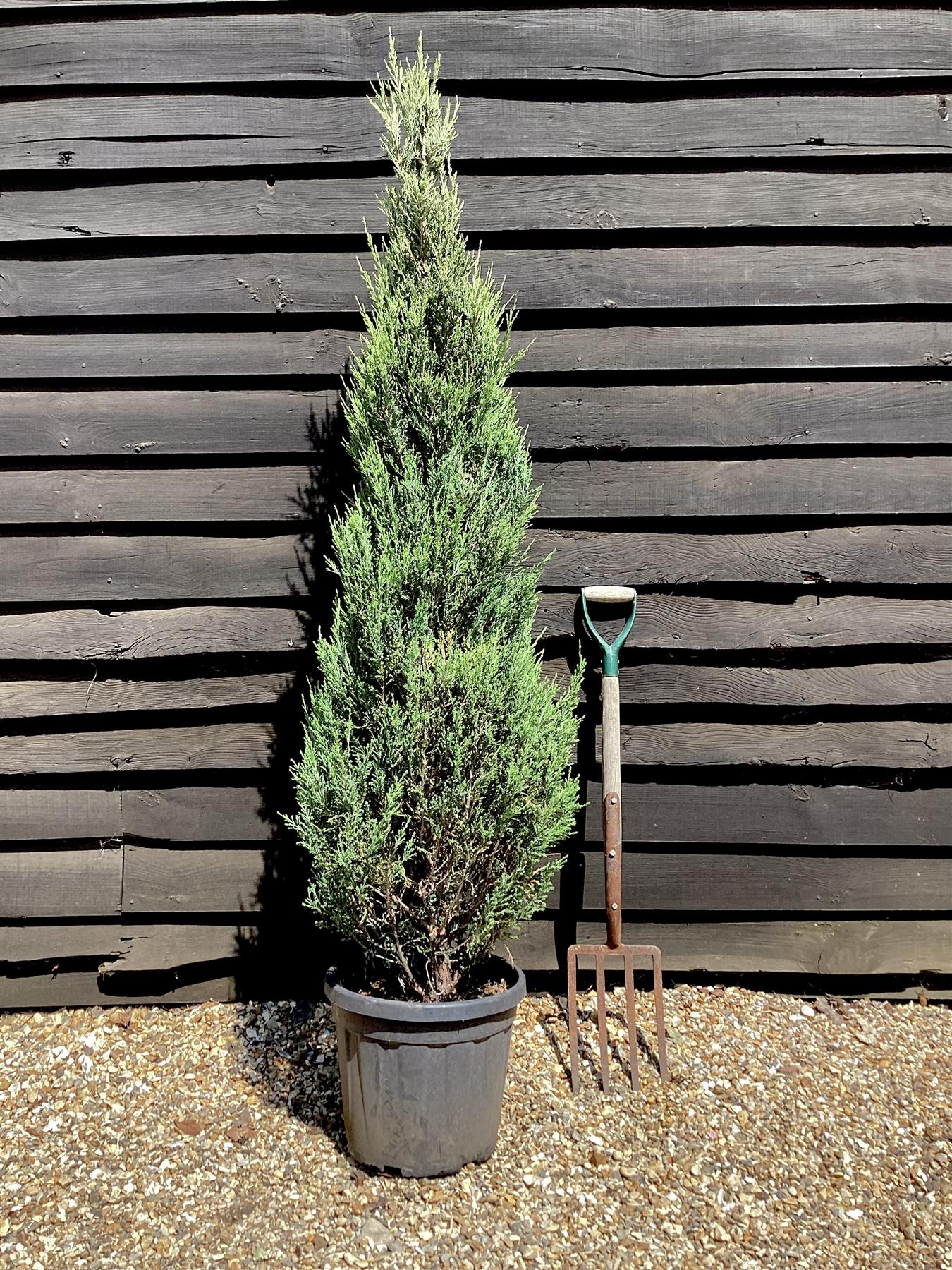

Cupressus arizonica var. glabra 'Glauca' | Arizona cypress 'Glauca' - 150-160cm, 25lt
£190.00
Unit price perCupressus arizonica var. glabra 'Glauca' | Arizona cypress 'Glauca' - 150-160cm, 25lt
£190.00
Unit price per


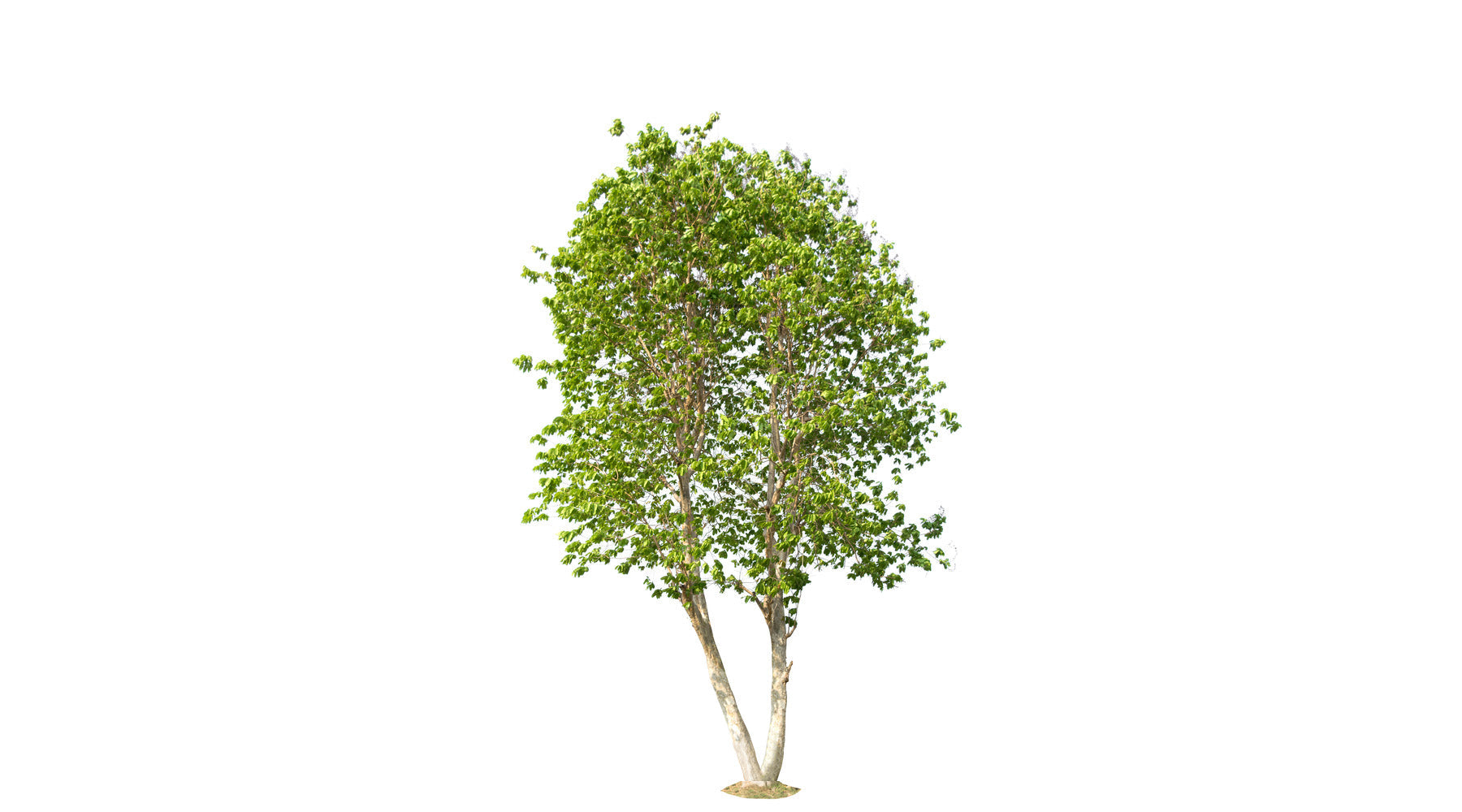
Liquidambar styraciflua 'Gum Ball' - Clear Stem 50 cm - Girth 6-8cm - Height 140-160cm - 15lt
£128.00
Unit price perLiquidambar styraciflua 'Gum Ball' - Clear Stem 50 cm - Girth 6-8cm - Height 140-160cm - 15lt
£128.00
Unit price per

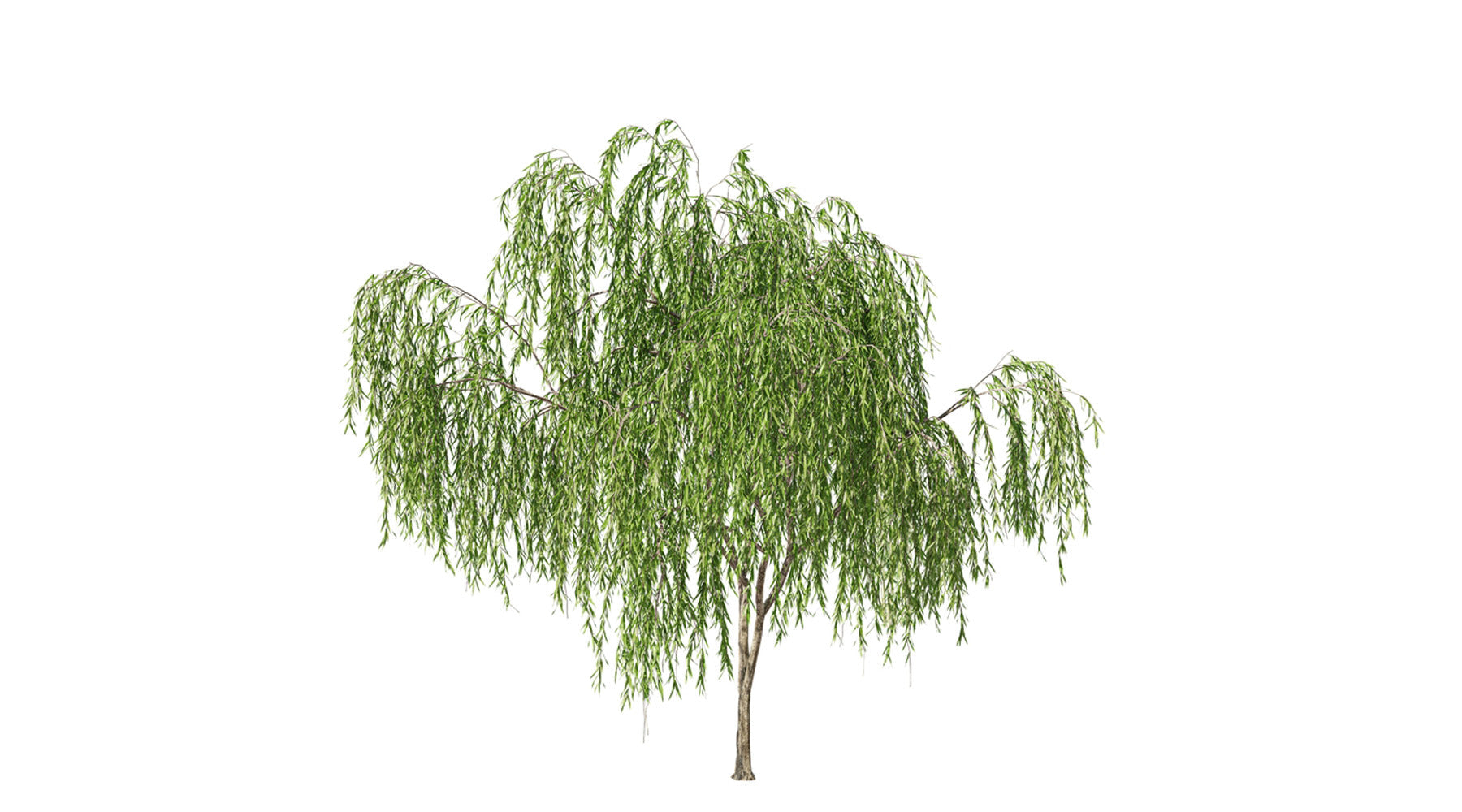
Salix Chrysocoma | Golden Weeping Willow - Height 230-260cm - 30lt
£138.00
Unit price perSalix Chrysocoma | Golden Weeping Willow - Height 230-260cm - 30lt
£138.00
Unit price per

Pinus nigra 'Komet' - 100-120cm - 18lt
£165.00
Unit price perPinus nigra 'Komet' - 100-120cm - 18lt
£165.00
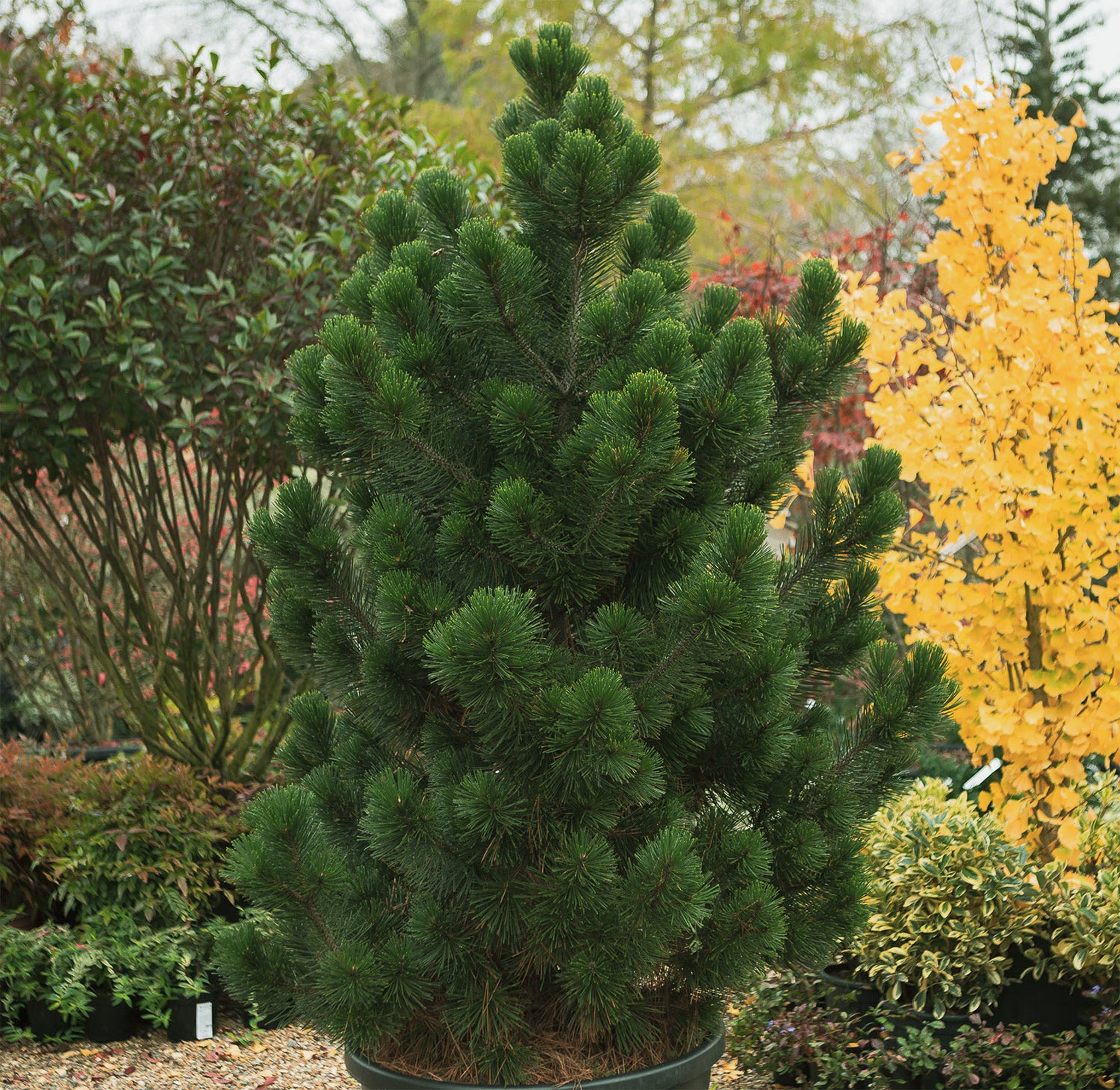
Unit price perPinus nigra 'Komet' is a stunning cultivar of the Pinus nigra species, commonly known as the Austrian or Black Pine. This striking ornamental tree stands out due to its striking conical form, fast growth rate, and dense foliage, making it a favorite among gardeners and landscapers alike. Native to Europe and Asia, the Austrian Pine thrives in a variety of environmental conditions, including rocky or sandy soils and urban areas with high levels of pollution.
The 'Komet' variety is characterized by its compact, pyramidal shape and distinct upward-curving branches, which give the tree its celestial namesake. This cultivar can reach heights of up to 30-40 feet (9-12 meters), with a spread of about 15-20 feet (4.5-6 meters). Its attractive form makes it an ideal candidate for use as a specimen tree, a privacy screen, or even as part of a larger garden design.
The foliage of the Pinus nigra 'Komet' is particularly striking, with dark green needles that measure 3-6 inches (7.5-15 cm) in length, arranged in bundles of two. These long, robust needles are accompanied by a dense arrangement of buds, which appear prominently on the tree during the winter months. The tree's bark is also visually interesting, with a rich, dark grey color and a plated or scaly texture that becomes more pronounced as the tree matures.
In addition to its aesthetic appeal, Pinus nigra 'Komet' boasts a relatively high tolerance to a variety of environmental stressors, including drought, air pollution, and saline soils. This adaptability makes it well-suited for urban landscapes and challenging planting sites.
When planting Pinus nigra 'Komet', it is essential to select a location with well-drained soil and ample room for the tree to grow to its full height and spread. Although this cultivar is more resistant to pests and diseases than some other conifers, it is still essential to monitor the tree for signs of infestation or illness, such as needle cast or pine wilt. Pruning is generally minimal and should focus on maintaining the tree's overall shape and removing dead or damaged branches.
In conclusion, the Pinus nigra 'Komet' is a magnificent addition to any garden or landscape, offering year-round visual interest with its conical form, dense foliage, and distinctive branching pattern. Its hardiness and adaptability to various environmental conditions make it a popular choice for urban planting and challenging sites, ensuring that this celestial-inspired cultivar continues to shine bright in gardens across the globe.


Pittosporum tobira - Shrub - Height 80-100cm - 10lt
£72.00
Unit price perPittosporum tobira - Shrub - Height 80-100cm - 10lt
£72.00
Unit price per


Pear - Pyrus calleryana 'Chanticleer' - 300-310cm, 35lt
£350.00
Unit price perPear - Pyrus calleryana 'Chanticleer' - 300-310cm, 35lt
£350.00
Unit price per


Acer pensylvanicum' | Moosewood Maple - 210-230cm - 20lt
£105.00
Unit price perAcer pensylvanicum' | Moosewood Maple - 210-230cm - 20lt
£105.00
Unit price perAcer pensylvanicum, commonly known as the striped maple, is a deciduous tree native to the forests of eastern North America. It is a small to medium-sized tree, typically growing between 5 to 10 metres tall, with a slender trunk and spreading branches that create a rounded crown. The bark of young trees is particularly striking, characterised by green and white vertical stripes, giving the tree its common name. As the tree matures, the bark darkens to a reddish-brown or grey, and the stripes become less pronounced.
The leaves of Acer pensylvanicum are large and broad, usually measuring 12 to 18 centimetres in length and width. They are three-lobed, with a slightly serrated edge, and have a soft, velvety texture. The leaves are bright green in spring and summer, turning vibrant shades of yellow in the autumn before falling. This autumnal display makes the tree an attractive feature in woodland settings.
In late spring, the striped maple produces clusters of small, yellow-green flowers that hang down in delicate racemes. These flowers are unisexual, with male and female flowers often found on the same tree. Pollinated by wind or insects, the flowers develop into distinctive winged seeds, called samaras, which mature in late summer and are dispersed by the wind.
Acer pensylvanicum thrives in cool, shaded environments, preferring moist, well-drained soils. It is commonly found in the understorey of mixed hardwood forests, where it grows slowly in the dappled light. The striped maple is also known for its ability to regenerate from stumps, making it resilient in disturbed forest areas.


Euonymus alatus Compactus - Height 20-40cm - Bushy - 3lt
£33.00
Unit price perEuonymus alatus Compactus - Height 20-40cm - Bushy - 3lt
£33.00
Unit price perEuonymous alatus is a large, dense, spreading deciduous shrub with oval, green leaves, that turn spectacularly scarlet-red in autumn. Tiny, inconspicuous, greenish flowers bloom in spring and summer, and are followed by highly ornamental purple and red fruits in autumn and throughout the winter. Bare winter branches are attractive because of their “corky” wings.
Euonymous alatus can grow in a wide range of soils, but thrives in average, medium moisture, well-drained soils. It prefers full sun and the best leaf colour is achieved in full sun, but tolerates partial shade and generally, pest-free. Attractive to birds.
It can withstand severe pruning, and has a tendency to be invasive. Euonymous alatus is a stunning shrub with beautiful fiery red autumn foliage, hence the name Burning Bush. It is perfect as a specimen plant, great for informal hedges and screens, wall-side borders, and shrub borders. Best-looking when planted against evergreens.


Picea glauca 'Sander's Blue' | Alberta spruce - Height 70-80cm - 15lt
£115.00
Unit price perPicea glauca 'Sander's Blue' | Alberta spruce - Height 70-80cm - 15lt
£115.00
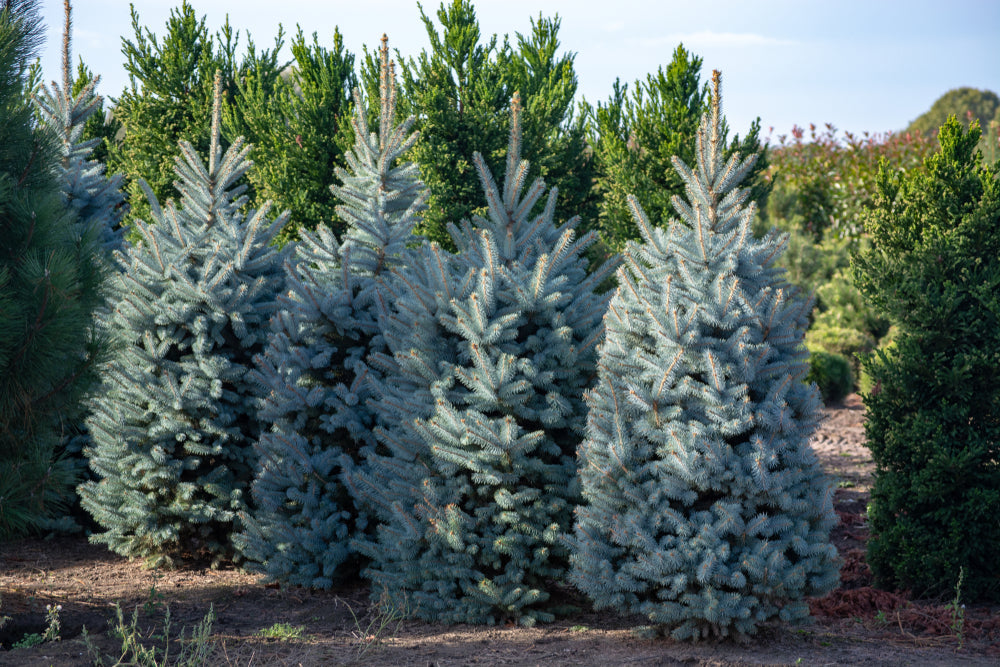
Unit price perPicea glauca 'Sander's Blue', commonly known as 'Sander's Blue' White Spruce, is a stunning dwarf conifer prized for its vibrant blue-green needles that add a colorful accent to any garden space. This cultivar exhibits a compact, pyramidal form, making it an excellent choice for smaller landscapes or as a focal point in a larger garden arrangement.
Typically reaching an ultimate height of 10 to 12 feet, with a spread of 4 to 5 feet, 'Sander's Blue' White Spruce grows slowly, which makes it manageable and suitable for residential gardens without the worry of overwhelming the space. It thrives in full sun to partial shade and prefers well-drained, moist soil. Hardy and adaptable, this spruce tolerates cold climates well, making it a versatile choice for various garden zones.
Gardeners often use 'Sander's Blue' as a specimen plant due to its distinctive color and structured form. It also fits beautifully into rock gardens, urban gardens, and even as part of a conifer collection, where its unique hue can be fully appreciated against contrasting greenery.